
Archive for the 'Articles' Category


Word to the RetailWise

Today’s ‘Word to the RetailWise’ is: Make sure your new hires know what is expected of them. And I want to illustrate that with this short, but very telling story.

Here it is…

In a store that is part of a large international retail chain, I recently witnessed something that gave me reason to believe that their new employees simply did not know what what was expected of them. And, here is why I drew that conclusion…

While checking out, I was the customer next in line behind a woman who was purchasing no less than 15 women’s blouses. 15! It was a great sale for the store. The other item the woman was purchasing was something of a carryall bag. The woman wanted the cashier to put the blouses into the bag – very environmentally friendly and all that, right?

So, as the cashier scanned each blouse, she removed the security tag and crumpled it up and put it into the carryall bag. Not folded, not even close to being folded. These blouses were being handled like something one would throw into the trash can. Seriously, I am not exaggerating.

Overcome with a sense of responsibility to defend every customer everywhere, I spoke up.

I said to the cashier “You know, this lady is buying all of these lovely blouses and you are not handling them very carefully. They’re going to be full of wrinkles and they’re brand new. I would be happy to help you fold them up.” Just a note here, the customer in front of me spoke very little English and that made it difficult for her to get involved in the conversation.

Some may say I should mind my own business but, in my line of work, it’s next to impossible to ignore these things.

I was ready for the worst…possibly a scene!

Anyway, to my absolute astonishment, the young cashier said, “You don’t have to help me. I’ll do it. That’s why I have a job.” I had expected a nasty stare, a flippant or sarcastic remark or, at the very least, a miserable attitude. But, no. The cashier – who I have not seen in this store before and am quite certain she is relatively new – proceeded to fold the items and then when it was my turn to be served  she continued to be very pleasant. What an employee…the kind we don’t come across very often anymore.

The moral of this story is: Teach your employees what is expected of them. This young woman; this new cashier simply didn’t know how she was supposed to handle the merchandise. She was very receptive to my ‘training’. I only hope I did not embarrass her. I commend her for her accepting attitude. But I must fault management for not having taught her properly in the first place. They basically set her up to fail.

All the Success!
DMSRetail Inc.

PS. Check out the Retail Business Academy, cashier performance course is in there too.

Effective Mentorship

This excellent summary of traits of highly effective mentors courtesy of Michael Hyatt:

Be a servant. Remember the mentee is the hero. You, the mentor, are the guide. Your job is to support, never to undermine, supplant, or steal the limelight.

Be observant. Notice everything, even details that don’t seem particularly relevant. Your advice is shaped by what you see. Make sure to see enough to have beneficial advice.

Be nonjudgmental. Listen to your mentee without sizing up and judging them. This doesn’t mean you have to approve, but influence takes access and judgmentalism will close the door.

Be curious. Ask good questions—this is more important than having the answers. A mentee will often come to the right answer on her own if she has the right questions.

Be authentic. Be who you are, even if it feels a bit old fashioned. Remember, as a mentor your most important asset is you—everything you know and have experienced.

Be calm. Cooler heads, as the saying goes, prevail. A good mentor can keep the temperature down. This is especially important when things get chaotic and others freak out.

Be confident. Mentees need wisdom and insight, not tactics—which they can get practically anywhere. Realize your experience is relevant, even if you don’t understand the nuances of the mentee’s industry.

Be reassuring. In the midst of challenging times, it’s easy to lose sight of our value and what we’re capable of. When the stakes are high, remind your mentee of what she has already accomplished.

Be courageous. Call on your mentee to make the difficult decision or have the difficult conversation. This is sometimes the only thing that separates success from failure.

Be generous. When the mentee achieves the desired result, give her the credit. Always interpret other’s actions in the best possible light.

Omnichannel Retailing

The future of retailing is shaping out to be one that combines physical with digital. Customers want the advantages of physical like being able to try on or try out the products they are considering, ability to interact with knowledgeable store personnel, and the overall social aspect of being out in the store.

They also want the advantages of digital—such as the ability of looking at a much wider selection, price comparison and reviews of the products by like-minded shoppers. It is becoming clear that the retailers who do a good job of combining both worlds are going to be the winners. Although the absolute share of digital retail is still small (9%), research shows that the 50% of physical purchases are influenced by digital information customers obtained before or during purchase.

Advantages of Physical

  • Ability to test, try on, or experience products
  • Instant access to products
  • Faster and more convenient returns
  • Help with setup or ongoing maintenance
  • Help and input from knowledgeable associates
  • Carefully selected assortment
  • Shopping as a social event and an experience
  • Instant gratification

Advantages of Digital

  • Broad product information
  • Other customer reviews, tips and advice
  • Price comparison from various sites and special offers
  • Wide selection
  • Easy (usually) and fast checkout
  • Anytime, anywhere access

Technology for a successful implementation of OmniChannel is readily available. For more information, contact John Callaghan at jcallaghan@dmsretail.com

See and Feel the Relationship Between You and Your Customer

What is at the foundation of Retail Store Design and Visual Merchandising?”  If I could boil it down to two principles that guide everything, it would be these:

1.  Don’t think.  Feel.

Now, don’t get me wrong here – I am about as strategic as they come regarding store design.  However, having said that, everything that I do in designing a store experience is targeted at the customer’s emotional response.  99.99% of purchases are emotionally based.  And I’m being generous with the 0.01% – I have yet to have anyone show me a purchase that they’ve made that doesn’t have an emotional element to it.  One famous example is: a presenter asks everyone in his seminar to look at their watch.  He explains, “If you spent more than $20 on your watch, it was for emotional reasons.”  In today’s world, a $20 watch will keep time just as well as a $6,500 watch.  (For that matter, we all have time on our cell phones, so who needs a watch?)  And yet, millions of people are still spending the additional $6,480 to make themselves feel special, elite, sophisticated, refined, discriminating, successful.  The same can be said for the store environment.  We buy things from stores that make us feel the way we want to feel about ourselves – stores that are in alignment with the way we want to be perceived by others.  In any purchase decision, feelings will always trump thoughts.  How do your stores make your customers feel?

2.  Stop looking at your stores through your own eyes, and start seeing them through your customer’s eyes.

One of the greatest values that we bring to our clients is the ability to see their stores through the eyes of an outsider – through the eyes of their customer.  You can do this too – and you must, if you want to connect with your customer.  Step outside.  Get some distance from your stores (literally, if you have to) and then come back and see them with the eyes of someone who has never seen them before.  Put yourself into the mindset of your customer.  What is their life like?  What do they want?  What do they need?  What do they worry about?  What do they aspire to?  Forget everything that you know about the behind-the-scenes operations, the company history, the insider knowledge of what you’re capable of as a company.  See only what is – what is in the space here and now – and see if it from the perspective of someone asking themselves, “Does this feel like me?  Does it feel like the me that I aspire to be?”  As a company there is likely a long list of things that you would want customers to know about you as they shop your stores.  Are the most important ones being communicated by the store environment itself?  And again, if viewed through the eyes of your customer, do your stores make you feel the way you would want to feel in order to be inspired to buy something just to be able to take that feeling home with you?

Most of us at one time or another during our upbringing, or during our education in preparation for entering the business world were taught to “dress for success.”  What that means and looks like will differ from person to person depending on their own unique personality, the response they’re hoping to get from people, and the environment in which they’re trying to succeed.  Stores are the same way.  Whether they’re “dressed for success” or not will depend on their unique personality (your Brand), the response they’re hoping to get from customers (the emotional reaction that leads to a purchase), and the environment in which they’re trying to succeed (the marketplace and competitor pool).  Successful store designs are a function of combining a series of seemingly minor elements – space planning, fixture selection, lighting, colors and materials, signage and graphics – that, when taken together become a powerful, emotional shopping experience.  It all begins with Seeing and Feeling the relationship between you and your customer.

Check out the “Retail Store Design and Visual Merchandising Workshop”

Lifetime value of a customer

Knowing how much a customer is worth to you over the long-term is the best way to convince yourself and your staff to become more committed and determined to treating your customers right and keeping them happy.

Calculating the lifetime value of a customer is reasonably simple. Take the example of your local supermarket. A typical family of four will spend approximately $200 each week on groceries and household items. Given that they are on vacation for two weeks a year, and say they are away for other reasons for another 2 weeks, that means they will shop at their grocery store for 48 weeks each year.

Over the course of a year, this single family will spend approximately (48 x200) = $9,600 at that supermarket. Now, let’s assume that the average family stays in their community for 15 years. Without taking into account inflation or the time value of money, that one family is worth $144,000 ($9,600 per year times 15 years) to that supermarket.

Now imagine the quality of service — be it speed, friendliness or special treatment – that family would get the next time they bought groceries if the store staff and the cashier knew they were worth $144,000 to the store (not just the $200 they were spending that day). It would probably be much better, wouldn’t it?

Suddenly, when you and your staff realize the lifetime value of customers to your business over the long-term, making decisions to benefit them (and not just your short-term interests or profits) become much easier. Take the time to figure out the lifetime value of YOUR customers. You might be pleasantly surprised.

Retail Success Accelerator is a product that is full of such practical, insightful and actionable ideas. Take a Look for Yourself-Click Here

All the Success! 
DMS Retail

PS. It is a combination of many little things that are done consistently which brings the ultimate success. Do yourself a favor and get a copy of the Retail Success Accelerator today.

How to Control Your Retail Business More Effectively-Part 1

One of the ways you can simplify controlling your retail business is through Gross Margin Return on Inventory Investment (GMROII) – commonly called JimRoy. It is, arguably, one of the most important Retail Key Performance Indicators (KPI).

Why is GMROII so important? Because it takes into account 3 very important operational activity areas in retail:

1. Sales performance

2. Desirability (demand) of the product (or buying effectiveness)

3. Profitability

Here is the formula for GMROII:

GMROII = GM% x (Sales / Avg. Inventory)

As a numerical example, if we assume Gross Margin of 33.33% and the store net sales of 24M over 12 months with 12 month average inventory of 4M, then:

GMROII % = 33.33 x (24 / 4) = 199.98% (some people use margin as a fraction, in which case this result becomes 1.9998)

Which means that for every $100 investment you make on your inventory, you get $199.98 back! Pretty good deal!

This metric is also a great tool for benchmarking similar stores, districts and regions as well as companies within the same retail vertical. It is also used to evaluate suppliers / vendors. You can apply GMROI to department, category, brand and SKU as well. A very versatile KPI indeed.

Keep a close eye on your GMROII, since through reporting of one number, you can reduce the amount of reports you have to look at or, at least, you will be consuming less time figuring out what’s going on.

Next week, we are going to dig even deeper into how you can manage your whole business through just one number

All the Success!

DMSRetail

PS. Retail Math-Made Simple, 3rd Edition has a lot of information on KPI’s and their calculations. Choose from an electronic download, printed version, DVD presentation or any combination. Learn how your retail business operates by the numbers.

You can check it all out here.

Seasonal Temps, like Michelle, Add Value

GoldenGiftBox400px

It’s that time of year again. Many retailers are on a mission to beef up their staff rosters so they’ll have enough floor coverage and extra help, to handle the increased traffic coming into their stores.

And, let’s face it, many of our customers may be subjected to some confused new hires who don’t know as much as they should. But let’s not be too quick to blame those new seasonal employees.

Even though many new seasonal hires may only be with you for a few weeks, they can add a lot of value if you do certain things right. Over the years, both as a customer and as a District/Regional Manager I’ve heard lots of comments about seasonal people…usually implying that something went wrong in service delivery, or mark downs, or visual display, or cleanliness or, whatever… due to the fact that seasonal people were involved.

That’s kind of unfair to them. If you’re going to invest the time and effort to recruit and hire people – seasonal or not – then you’ve got to make the most of the investment. There’s no room for the excuse “s/he’s just a temp” when it comes to your store(s) and your company’s reputation.

One of the greatest benefits of hiring seasonal employees, like the one in the story below, is that you get to see them in action; it’s like a working interview and you can determine quickly and easily if the seasonal employee is someone you’d like to bring on permanently after the holidays.

Lots of retailers get some of their ‘gems’ this way, and here’s why…

People who are looking for seasonal employment may not be your regular job seekers. Some want to get into the workforce temporarily to earn a bit of extra income, and some may want to see if retail is something they’d like. Others may find that it’s easier to land a job when so many employers are trying to find people.

Here’s a true story about one seasonal employee that I hired…

Michelle was new to the country and, although she interviewed very well, you could see that she was a little self conscious about her language skills. It was clear that she was bright, well educated and very enthusiastic about getting the job.

We hired Michelle as a cashier and she worked out very, very well. She was excellent at adding on merchandise at the cash desk.

Then, one day, we needed her to cover out on the sales floor. She was a bit apprehensive but she agreed. Michelle displayed a lot of natural talent but needed a little confidence building.

After a couple of hours of training on the basics of the selling process, she was amazing. Obviously, it helped that she was a very willing student.

Anyway, once she got going, there was no stopping her. And, you guessed it, we hired her on a permanent basis at the end of the season. Definitely a win/win.

Whatever the reason, once hired, many people shine just like Michelle did.

There have always been at least a few seasonal employees that I encouraged Store Managers to hire on a permanent basis following the holiday period.

Of course, there are the others as well…the ones that make you say “What were we thinking?”. You know…the party animals who show up late for their shifts looking like death warmed over, and the chatterboxes, and the timid onesstanding as far away from customers as possible, and the loud, boisterous ones who think they know everything (when they clearly do not), and the list goes on.

But, what do you do once the season is well underway? These are the people you have so you often end up putting up with them.

But, if you really want to add value to the seasonal hiring effort this year, there is something you can do to get something beneficial out of the process.

You don’t have to put tons of time in or take your other people out of their stores/districts to make this happen. If you have hired seasonal employees who are new to retail, or sales and customer service functions then give them something that they can get through quickly and easily.. something that will help them get ‘in tune’ with what you expect from them and give them some skills to bring to the job.

Give them a little training; something that they can do on their own, and the party animals, the timid, the chatterboxes and the know it alls will, at the very least, understand that you expect more from them and that you’re investing to make sure you get what you expect. We guarantee it.

I’ve seen lots of people, just like Michelle, who turn out to be worth their weight in gold.

This time of year is way too important to leave this to chance. If you can help your new people get up to speed quickly enough to make a difference this season, why wouldn’t you? Consider this very simple example.

Your seasonal employee, Jane, will help clean and organize the stockroom, she’ll change lightbulbs and keep displays tidy, she might even be a really friendly greeter when positioned at your lease line. You may be very happy with Jane.

But if Jane learns some sales & customer service skills she can be more productive by actively selling to customers, in addition to her other duties.

Depending on your average sale, if Jane made just a couple of decent sales, you’d quickly recover any investment you made in training her and it would prove to be very worthwhile. And, she would thank you for taking the time to help her, as well.

In addition to monetary gain through increased sales, you also get more commitment, respect and loyalty.

You can decide to make your seasonal employees a very valuable asset this year.

All the Success!

DMSRetail

P.S.: If you’re looking for something to help you realize your investment in your seasonal employees, here it is. Get your copy of the Retail Selling Skills & Customer Service Fundamentals Self Study Course now. The digital version is only $97. In just a couple of hours, your new employees will learn how to contribute so much more to your business.

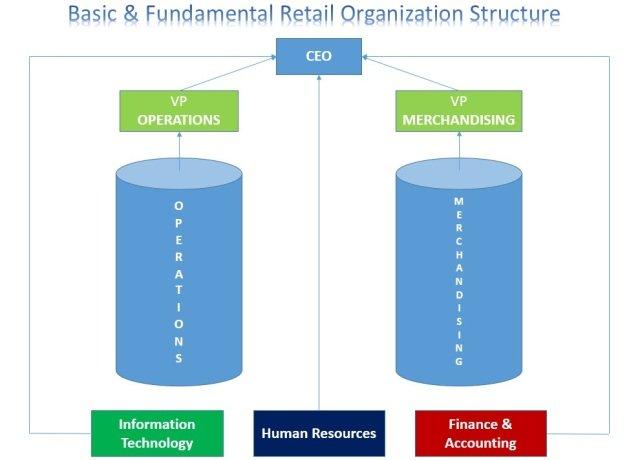
One of the critical profit issues in retail is to make sure that the 2 engines of a retail organization, namely Merchandising and Operations, work as a team. Because of the built-in tensions between these 2 engines, many retail companies have a difficult time creating the working relationships that would generate the synergy required to maximize productivity and profits. Following diagram summarizes a fundamental retail organization structure:

RetailOrgChart640px

Obviously, the quality of contribution and support from other functions like Finance, IT and HR is very important as well. All these functions must align around the vision of what needs to be achieved and when.

One of the most effective ways of making people work together, is to tie their compensation to the over-all performance of the organization. This is as important as, if not more important than the culture building and/or other soft approaches to performance leadership.

What we see in many retail organizations is only the top management has their compensation tie in to the performance of the company. This is where many retailers go wrong. Realities of doing it for all levels are obviously much more complex and require some serious effort. But that’s the price of winning at retail just like in anything else.

Business/Profit Multipliers

There is a technique called Business/Profit Multipliers that you can use when dealing with a reality of big increases required, or requested by your higher management team.

Let’s assume that the objective is a 25% increase in sales. This number, looked at by itself, is somewhat scary.

Here is how you may want to approach it. Let’s first look at the present scenario:

Traffic: 1000 / week
Conversion: 25%
Average Units / Customer: 2
Average Price: $25
Average $ / Customer: $50
Weekly Sales: 250 x 50 = $12,500

Now instead of talking about a 25% increase, let’s look at increasing each one of our operating variables by only 10%:

Traffic: 1100 / week
Conversion: 27.5%
Average Units / Customer: 2.2
Average Price: $27.5
Average $ / Customer: $60.5

Weekly Sales Become:
Customer # Converted: 1100 x 0.275=302.5
Average Ticket: 2.2×27.5=60.5
Weekly Sales = 302.5×60.5 = $18,301.25
% Increase: (18,301.25-12,500) / 12,500=46.41

In fact, for the above scenario, to achieve a 25% increase overall, you only need to increase your operating variables by 5.5%.

Much easier to sell it to your subordinates and get a buy-in, isn’t it?

Many more practical and actionable techniques, methods and insight in the Ultimate Retail Success ToolKit.

7 Deadly Sins of Customer Service

You probably have seen the following before, but it is so valuable we just thought you would enjoy it again regardless.

Seven Deadly Sins of Customer Service

1. Apathy: A just don’t-give-a-damn attitude on the part of the salesperson or an impression conveyed to the customer in terms of “Do I look like I give a damn?”. Some people get this way when they get bored with their jobs and nobody is reminding them that their job priority is to serve the customers.

2. Brush-Off: Trying to get rid of the customer by brushing-off his or her need or problem; trying to “slam-dunk” the customer with some standard procedure that doesn’t solve the problem but lets the service person off the hook for doing anything special.

3. Coldness: A kind of chilly hostility, curtness, unfriendliness, inconsiderateness, or impatience with the customer that says, “You’re a nuisance; please go away.” It is amazing to find that so many restaurants carefully select the most moody, depressed, hostile person they can find for the hostess-cashier job, making sure the customer’s first and last moments of truth are good ones.

4. Condescension: Treating the customer with a patronizing attitude, such as many health-care people do. They call the doctor “Doctor Jones,” but they call you by your first name and talk to you like you’re four years old.

5. Robotism: “Thank-you-have-a-nice-day-NEXT.” The fully mechanized worker puts every customer through the same program with the same standard motion and slogans, and with no trace of warmth or individuality. A variant of this is the smiling robot who gives a permanent “star” smile, but you can tell nobody’s home upstairs.

6. Rule Book: Putting the organizational rules above customer satisfaction, with no discretion on the part of the service person to make exceptions or use common sense. Banks are famous for this; they usually do everything possible to eliminate all traces of human thought and judgement, with the result that no one is authorized to think. Any customer problem with more than one moving part confounds their system.

7. Runaround: “Sorry, you’ll have to call (see) so-and-so. We don’t handle that here.” Airline people have made this into an art; the ticket agent tells you the gate people will take care of it, and the gate people tell you to see the ticket agent when you get to your destination, and the agent at your destination tells you to have your travel agent take care of it.

You can improve your customer service by training your front line staff with DMSRetail’s Retail Selling Skills & Customer Service Fundamentals DVD course.


Enter your email address to follow this blog and receive notifications of new posts by email.

Retail Management Success

Ultimate Retail Success Collection

Retail Business Academy

Retail Business Academy

Archives

Sales & Influence Blogs - BlogCatalog Blog Directory