Archive Page 12

The Lifetime Value of a Customer

Knowing how much a customer is worth to you over the long-term is the best way to convince yourself and your staff to become more committed and determined to treating your customers right and keeping them happy.

Calculating the lifetime value of a customer is reasonably simple. Take the example of your local grocery store. A typical family of four will spend approximately $175 each week on groceries. Given that they are on vacation for two weeks a year, and say they are away for other reasons for another 2 weeks, that means they will shop at their grocery store for 48 weeks each year.

Over the course of a year, this single family will spend approximately (48 x175) = $8,400 at that grocery store. Now, let’s assume that the average family stays in their community for 15 years. Without taking into account inflation or the time value of money, that one family is worth $126,000 ($8,400 per year times 15 years) to that grocery store.

Now imagine the quality of service — be it speed, friendliness or special treatment – that family would get the next time they bought groceries if the cashier knew they were worth $126,000 to the store (not just the $175 they were spending that day). It would probably be much better, wouldn’t it?

Suddenly, when you and your staff realize the lifetime value of customers to your business over the long-term, making decisions to benefit them (and not just your short-term interests or profits) become much easier. Take the time to figure out the lifetime value of YOUR customers. You might be surprised.

All the Success

DMSRetail

PS. Checkout the website for additional insights, tools and resources:

More articles like this: http://www.dmsretail.com/ViewPoint.htm

Courses:   http://www.dmsretail.com/retailmanagementcourses.htm

Success Guides: http://www.dmsretail.com/retail-success-guides.htm

Ultimate Resource:

http://www.retailmanagementportal.com/retailsuccesscollection.html

Retail District Managers – Sharpen Your Leadership

Did you know about these dramatic differences between the weakest and the strongest retail leaders? (Research: Zenger-Folkman)

4-6 times higher profits

6 times higher sales revenues

10-20 times higher levels of employee engagement

3-4 times reduction in employees thinking about quitting

50% fewer employees that do leave

Double the satisfaction with pay and job security

4-5 times more employees “willing to go the extra mile”

1.5 times higher customer satisfaction ratings

Did you also know?:

“According to operating data from various retail organizations, District/Area/Region Manager can influence performance by up to +/- 20%” – (DMSRetail Research)

In actual numbers, that means, if you have a district of 10 stores with $1.5 Million average sales each, District Manager’s influence is about 6 Million dollars between -20% and +20%.

No responsible retail organization can leave this kind of influence to chance. Apart from hiring (or better yet, promoting from within) great managers, organization has to make sure that they are well equipped with the right tools and training.

This is where DMSRetail comes in. With our proven, real life experience and record, we are able to get your talent to the point of peak performance, so that your District/Area/Region manager can consistently deliver at the +20% range.

And we do it in style in Fabulous Las Vegas! (March 2-3, 2015)

Here are some comments from the previous participants:

Illuminating, challenging and entertaining Amanda R., Retail Business Owner

“Very good information, gave many tools to be a very successful DM.” Leland W., District Manager

“It was informative on key pieces of the DM role.” Alissa B., Corporate Trainer

“Great! Felt, after an hour on the first day, that it was well worth my time away from the store.” Kim H., Sr. Store Manager

“I think this class has made me a better DM. I can put a lot of the systems I saw into play in my stores.” Calvin D., District Manager

“I think this workshop was perfect for our company. The way we are growing, I truly felt that we needed to structure the DM position. This workshop has given us the tools to do so.” Nick G. District Manager

“I enjoyed/learned from your experiences and it is important to learn from workshops like yours because we do not have the time to learn all these things on our own. Stand on the shoulders of giants!” Bill G. District Manager

You can get all the details and sign up here:

http://www.dmsretail.com/districtworkshop.htm

As Always,

To Your Success!

DMSRetail

PS. Las Vegas Workshop is coming up very soon March 2-3, 2015,

so don’t wait register today! Right Here:

http://www.dmsretail.com/districtworkshop.htm

Retail Success Tips & Strategies

If there is one lesson to be learned from Target’s massive failure in Canada, it’s the fact that solid management and leadership ability are still the most important ingredients for success.

We must also understand that not every manager who is running a retail business is equipped with the innovative ideas and tools…or, even the fundamental and necessary ideas and tools… to make sure their operation becomes or remains successful.

A lot of retail managers keep doing the same things, over and over again, expecting different results. By the way, this previous sentence is widely recognized as the definition of insanity.

A lot of retail managers are running around talking about, and seeking information on, the latest and greatest technology, when their very foundation of infrastructure type systems are not correctly in place and may, in fact, be crumbling.

And there seems to be a malaise that affects most retail managers causing them to avoid the study of better and more effective strategies, tips and tactics. It may even be a degree of arrogance among retail managers … everyone thinks they know everything already.

How do you break this vicious cycle?

You need to inject different ideas.

What kind of ideas?

Ideas that have been time tested and proven. Yes, apply the proven ideas first just to be on the safe side. There will be plenty of time for innovative ideas once the solid foundation is built.

Where do you get these ideas?

From people who have been there and done it successfully. They may, or may not, have gotten the T-shirt.

We are those people. But, we don’t expect you take our word for it. You can check out hundreds of testimonials on our website.

So, if you want to get some sharp ideas that will actually MAKE a DIFFERENCE, join us for the

Retail Success Tips & Strategies webinar this Wednesday, January 21, 2015.

If you register and then find that you are unable to attend, for whatever reason, we’ll send you the recording.

Admittedly, it is not free, it is not even cheap, but that’s how life is.

Good things are usually not cheap. But, one thing I can guarantee is that you will recover your investment 100 times over if you implement even one strategy from this webinar.

All the Success!

DMSRetail

PS: Don’t procrastinate…sign up now. Go here to sign up.

When Focus is not on Target

So, by all accounts a really good retailer in the USA, Target is a bust in Canada!

Who would have thought that Target would have to close up shop, literally, and leave the country? As all the reports say, Target’s missteps into the Canadian market will become case studies for many future students of retail management.

And, rightfully so. However, while many are busy listing the reasons why Target Canada failed and are suggesting various solutions that would have saved them there is really only one thing that went wrong and it is critical that the  case studies focus on this or nothing will be learned.

Target Canada was a victim of bad management. Everything else stems from that fact.

Yes, the supply chain was an issue, and they didn’t do a good job managing expectations regarding pricing and they didn’t have a web presence, and some of their Zellers locations were duds (and better management would have realized which ones they were and steered clear of them for a while) but none of these things would have happened if Target Canada was managed by someone with better skills.

It’s really that simple. The things that went wrong were not natural disasters, nor were they things that   were impossible to foresee. The fact that they were not foreseen means someone (or everyone) was asleep at the wheel…or the switch, or whatever you want to call it.

I have seen no end of reports written – and sometimes pictures -about the empty shelves and the missing Canadian Target website. I even saw one report that said Canadians simply haven’t taken to one stop shopping yet. Excuse me? In the great, white north where cold winters are long and harsh…Canadians would rather run all over town getting in and out of their cars to shop in several different places? I think not.

And, even if it were so, then it would follow that Wal Mart is leaving Canada also, right? No?

That’s what I thought.

There are the reports that Target couldn’t compete with Wal Mart and Costco. And, in the USA these competitors do not exist?

Oh, and according to some…they couldn’t compete with Sears Canada and Giant Tiger. Seriously?

When Target first announced that it was coming to Canada, Canadians were thrilled with the prospect. Many of us have done lots of shopping in the USA and are no strangers to Target.

Naturally, expectations were high…we knew what to expect of Target based on our experiences in their stores south of the border. So, when they showed up in the lousiest of old Zellers locations…with empty shelves and higher prices, it was disappointing.

Quite a big let down, actually.

So, what is it? Are they just lucky in the USA? Why do they do well there and tank here in Canada? And, no one should settle for a list of all of the ‘things’ that went wrong being the answer to that question. It’s, at the same time, more straight forward and much more complicated than that.

Some more important questions: Who made the decision on who would be in charge of the move into Canada? And, what was that critical decision based on? There are some who say it was arrogance – that Target USA saw the move into Canada as a slam dunk…or like taking candy from a baby. Either way, bad management is still the issue.

The big questions have to be answered by people at the highest levels of Target. It would be a huge mistake for them to list the reasons why things went wrong, clean up the mess, take their financial lumps or write offs, and leave it at that.  If they do, they’ll be none the wiser in future and this multi-billion dollar lesson will be wasted.

The case studies that are developed must not only focus on the ‘things’ that went wrong. They must focus, first and foremost, on the quality of management and how the lack of high caliber management was, in fact, responsible for the disaster that was Target Canada.

I can hear it already. Some people will quote Murphy’s Law and others will say “stuff happens… you can’t put all the blame on management”. Well…why not? Is it not reasonable to expect the management of a company to know what they face when undertaking something as important, and expensive, as a launch in a new market that just happens to be in another country?

Should they not have examined the supply chain situation just a bit closer seeing as so much would be riding on it? Should they not have sought out better intel from knowledgeable resources, about Canadian shopping habits; about the importance of a Canadian web presence; about locations that are dead or dying? And, so on?

It’s understood that hindsight is 20/20. And, if a couple of things were overlooked and then identified as problems and corrected quickly enough to save the day, then we might just be able to say that management did its job. After all, no one is perfect.

But, that is not the case here.

Do not be tempted to make excuses for poor management. We must insist that management be accountable. Always. Everything else being equal, caliber of management makes the difference between the success or failure of a company. This is where the case studies need to focus.

Too many retailers and, in fact, companies in general just do not pay enough attention to who they give the keys to. Or, the major projects… the tough but exciting jobs.

I had major surgery once. Do you think I chose the Doctor by asking who had been around the longest? How do you suppose that moon landing teams are chosen? Seniority? I seriously doubt that. Just about any serious endeavor requires good people…some would say the best people. Never the ones that happen to have been here the longest with that being their only qualification or claim to fame. And, certainly, never the ones that just happen to be willing to relocate.

A major project with a lot of shareholder money riding on it is serious business. Target executives, I’m pretty sure, are aware of this. So, how could they fall into this trap?

It does seem that retailers, in particular, tend to promote, and keep promoting, the employees who have seniority – whether they’re any good or not. Sometimes, the only reason they have been around so long is because they aren’t really that great and they know it. Of course, they stay. Usually, these individuals are serious ‘yes’ people because to be anything else would be detrimental to their long term career plan. Often, they do not have the knowledge to be anything other than ‘yes’ people, either. Remember, I did say sometimes.

There is no doubt that experience counts. If a long term employee has proven him/herself to be a great leader and has the other attributes that make him/her a good choice for the big project – like taking your business to a new country – then that person may be the perfect choice. If the person was the perfect choice, or even just the right choice, then the team s/he chose would also have been, at bare minimum, competent and in all likelihood strong players and we would not be talking about Target Canada in these terms today.

It appears that key management players who were involved in this unmitigated failure were (some still are) long term Target employees. Whatever the case, someone who should have known better, wasn’t thinking all that clearly when they put Team Target Canada together.

#2 – Flyin’ vs Dyin’

Yesterday, we started a conversation about getting too many emails that aren’t relevant to your business which just means you spend a lot of time pressing the delete key.

But, as many of you agreed, every so often you get an email that gives you food for thought, or a little piece of advice that really hits home and actually gives you some help with something that you may have been struggling with for a while.

Of course, not everything will be equally helpful to each of you because we have a lot of subscribers…from every level and type of retail management.

In any case, we all have the same goal in mind…to grow our retail business; make sure that same store, or comp store, sales and profits increase and that expenses are under control.

Improving and moving forward is a must, not an option. And, as we discussed yesterday, it’s tough to keep the forward momentum going, year after year, without getting some new ideas, advice, practical tips and how-to’s.

Things are always changing and we need to be on our toes all the time.

We want to help you with that forward momentum. We want to accompany each of you on that journey. DMSRetail has a wealth of information you can use, right now, to ensure your business is flying and not dying!

Today’s installment is about sharing information within the organization, and coaching…which just happen to go hand in hand.

Coaching and Information Sharing 

Highly successful Retail Managers excel at, and believe strongly in, information sharing. It is part of the management style we discussed earlier.

They stress that sharing information, continuously, is the best way to coach people. Of course, sometimes the coaching has to be more formal with time set aside for conversations on particular subjects. But, for the most part, they find that their general style of sharing information doubles as coaching.

Using every conversation to coach your people has a remarkable effect. Employees are picking up information as you speak and they can determine, for themselves, if this is something that they can use for their own betterment. Remember, highly successful Retail Managers have high quality people working for them and those individuals have been given a lot of autonomy so they often know what they need to pick up from a conversation. If the Manager doubts that the information is being understood properly then they can be more specific.

It is not always necessary to point out a deficiency if an information sharing conversation will have a more positive effect. It works.

The key word is share. Information is a great thing to share. All of us need information in order to perform well. The more information we get, within reason, the better we are able to perform.

If you do not share non-confidential information it may be because you are concerned that:

  1. The employees cannot handle the information. You could be correct about this, depending on the situation. Perhaps the employee is new or there is some other reason but you need to take it upon yourself to make sure that, at some point, the employees can handle the information you have to share.
  1. The employees may end up knowing too much. Take the approach that they can never know too much if it helps them do their job and look after the best interests of the company. A highly successful Retail Manager is confident that sharing non-confidential information is not going to jeopardize their position. Surrounding themselves with employees who have extensive knowledge and information is what they strive for. If the employees happen to know more than the Manager, so much the better! Maybe you can learn something from them, too.
  1. You don’t want to take the time – the great deal of time you must invest – to share. If this is the case, you cannot be successful. Keeping information to yourself simply increases your workload and stress level and does nothing to further the cause or develop employees.

Sometimes we need to talk with an associate to tell them what we have observed and how they might be able to do better next time.

Taking a positive approach yields more positive results.

Remember, coaching is something that never stops, no matter how good your team gets. Only your approach should change; being mindful of their status and ability.World Champion athletes who are at their peak performance levels didn’t get there without a coach. And they can’t hope to stay in the game for long without their coach’s help.

We hope you found this email helpful in some way. You’ll find these coaching tips and much, much more in our Ultimate Retail Success Collection and you can check it out here.
Stay tuned for tomorrow’s installment.

All the Success!

DMSRetail Team

PS:  The Retail Operations Management Workshop and the Retail Category Management Workshop take place in Miami in February. Click the links for Dates, Program Outlines, Fees, etc. Register soon to avoid disappointment.

PPS:  We’ve just completed our 6 month Schedule of Workshops. Send an email to training@dmsretail.com to request a copy.

Food for Thought About Flyin’ vs Dyin’

If you’re anything like us, you get too many emails that are not relevant to your business, or not relevant to your business at the moment. So, you spend a lot of time pressing the delete key.

But, every so often you get an email that gives you food for thought, or a little piece of advice that really hits home with you; helps you with something you’ve been struggling with for a while.

This is the time of year when many retailers are taking a long, hard look at their business results for the previous year and start making plans to ensure this year is better. Regardless of what the previous year looked like, you’ve got to do better this year, right? That’s the way to grow our businesses…keep doing better in comparable stores; maybe add some new stores, or even some new revenue streams.

The idea is to go forward, in any case.

It’s tough to keep the forward momentum going, year after year, without getting some new ideas, advice, practical tips and how-to’s. Things are always changing and we need to be on our toes all the time to stop us from rolling backwards or, even, from maintaining the status quo.

We want to help you with that forward momentum. We have a wealth of information you can use, right now, to ensure your business is flying and not dying!

For instance, you would be a rare retailer if you don’t have at least a few problem employees. You may already understand that you have them because your hiring practices aren’t as sharp as they might be. Perhaps a lot of canned questions are being asked during interviews which, of course, leads to canned answers and you and/or your management people aren’t getting at what you really need to know about the applicant making it impossible to predict what they’re going to do for your organization.

Here are a few Questions and Tell Me’s designed to get right to the heart of the matter. Ask these and you will learn a lot. If the candidate gives really short answers…you’ll have lots of information to use to drill down. Any retail candidate should have no problem with these. If they do, head’s up.

Customer Service Orientation

What basics do you think the customer has the right to expect when in your store?

Tell me a few things about telephone etiquette.

What are the elements of a positive shopping experience?

Ability to Sell, or Coach Others on Selling Skills

What are the steps in the selling process?

Elaborate on those steps as much as you can.

Do you consider yourself a good salesperson and, if so, what indications do you have that support

your answer?

And, of course, it’s always a good idea to hand the candidate your pen or notebook or other object and have them sell it to you.

Attitude

How important was your personal contribution to the goals and objectives of the business unit

you last worked in?

Can you give me an example of a company procedure or policy that did not make sense to you?

How do you communicate your agreement/disagreement with company initiatives?

Relationships and Team Building

Tell me about your past relationships with your subordinates/peers.

Tell me about your past relationships with your superiors.

What type of Manager would bring out the best in you?

We hope you found this helpful in some way. You’ll find these interview tips and questions along with the expected and acceptable applicant responses and much, much more in our Ultimate Retail Success Collection and you can check it out here.

Stay tuned for tomorrow’s installment.

All the Success!
DMSRetail Team

PS: The Retail Operations Management Workshop and the Retail Category Management Workshop take place in Miami in February. Click the links for Dates, Program Outlines, Fees, etc. Register soon to avoid disappointment.

PPS: We’ve just completed our 6 month Schedule of Workshops. Send an email to training@dmsretail.com to request a copy.

Holiday Tip #3

Today, we want to share a story of one Store Manager who figured out how to overcome poor store performance.

But, first, let’s answer this question…

If there was one thing that you could point to as the most important thing you can do, in this final quarter of the year, to give you the best possible shot at closing the year with a degree of success, what do you think it would be?

The answer is to effectively manage the performance of the people in your retail store(s).

Your retail store isn’t going to change much except for the usual visual merchandising and possible layout changes; all of your retail management training has been done; the inventory has been bought and will, hopefully, arrive in stores as scheduled; your POS system will be the same; your marketing and promotional efforts are probably all developed and ready to implement, except for some last minute attempts to give business a lift; and, unless something goes terribly wrong, you won’t be making any changes in your retail management teams until next year.

The only thing that can significantly change that will really make the difference over the next few weeks is…
You guessed it…the people working in your stores.

If you’re in retail, you know it’s all about store performance and you simply cannot expect superior performance from the store(s) if the people dealing with your customers aren’t performing at the expected level.

Here’s the story, we mentioned above, written by a Store Manager who learned how to solve her concerns about store performance…

************************************************************************************************************
“When I got my first Store Manager’s job, I was almost overwhelmed by the number of things I had to accomplish. In fact, there is so much involved in managing a store that, without the benefit of experience, a Store Manager could easily lose sight of what is really important.

During that first few months it seemed like I was doing everything I possibly could to get the sales results. I was hiring and training people, scheduling really carefully so as not to overspend on wages while still keeping my sales floor properly covered; constantly moving merchandise around so that customers would always be treated to a fresh look when they came in; I was coaching and motivating my people all the time. Really, I thought I was doing the job.

But, even though I was working incredibly hard, I still wasn’t getting the sales I knew the store was capable of generating.

Then, one day, I really started taking a close look at what my Sales Associates were doing. They were a great bunch of people and they worked very hard for me. I realized that, although they were all doing everything I asked of them and they were all super friendly with the customers, they weren’t really actively selling to them. Eureka!

It was definitely the most exciting aha! moment in my career up to that point.

I finally got it…I had to teach them how to actively sell to customers! Honestly, they had been doing the best they could; the best anyone could ask of them given that they had never actually been trained to sell. Who knew? Most of them were following some of the selling steps involved intuitively, but there was something missing…

Being very good at selling, myself, I realized I had long ago developed my own unique way of selling…but I didn’t start out that way. In the beginning I had to rely on the selling steps that I had learned to ensure I covered everything in the process.

You really can’t miss any of the steps until you’re very experienced; experienced enough to read the customer and to make changes to the process…changes which enhance it; not changes to shortcut it.

So I got fully behind a project to get all of my Sales Associates up to speed with an active selling skills program. It wasn’t difficult and it wasn’t time consuming.

I could have kicked myself because it had taken me so many weeks to figure it out.

Anyway, once I did finally figure it out I got my people the help they needed; the training they needed. They learned how to use the active selling skills steps and the rest is history.

Not only did my store’s sales improve by about 60%, which did wonders for my reputation in the company and was, undoubtedly, the reason for my fast promotion to DM, but the morale in the store was impacted in a major way. Everyone got amazing results. Well, almost everyone. A couple of really shy, introverted associates took a little time to warm up but, eventually, they did great too!

All of my Associates were beating their targets every shift, every day, every week. It was astonishing.

My Sales Associates were filled with the energy and excitement that comes with that kind of achievement. You should have seen the big sales chart in the back room…gold stars and smiley faces all over the place! The staff were renewed and the store was beating the targets like never before. And not just total sales compared to target and last year,either!

All of the KPI’s were being blown out of the water.

Our biggest gains were in conversion % – you know, the rate you turn shoppers that come through your doors into purchasers. I just would not have believed that my staff were missing so many opportunities before. They had always been great with customers and they worked hard to make sure customers were satisfied. I can see now, because hindsight is 20/20, that they simply did not have the skills to do better.

Our average sale per customer and units per transaction shot up too. Of course, once you start actively selling to customers instead of just helping them, all of your key performance indicators will improve dramatically…anyone could increase their KPI’s, couldn’t they?
Yes, yes, indeed they could and would.

I know that now but, like I said, hindsight is 20/20!

I’m a true believer in giving Sales Associates and Cashiers and anyone else who interacts with customers on your sales floor, the benefit of proper training – the tools of the trade, so to speak – in active selling skills… and in customer service basics, as well.

I’m also a true believer in staying on top of everyone’s performance…every hour of every day. I know that it’s my job, as the Store Manager, to make sure the job is being done well, at all times.”

******************************************************************************

That’s her story.

If you want to put your store performance concerns behind you, take a page out of this Store Manager’s playbook and get the big store performance solution we’ve created for you…

Retail Success Accelerator

Just so you know, you’re certainly not alone with your store performance issues and concerns. There are plenty of retailers out there experiencing the same things.

The Retail Success Accelerator, a compilation of three of our top store level problem solving products, is available in digital format for only $297.

Order and the files will be delivered to your inbox. Get started right away.

Here’s what you get when you order the Retail Success Accelerator:

#1: Store Management for Maximum Success Study Course – individually priced at $197

#2: Super Retail Success Bundle – individually priced at $147

#3: Retail Selling Skills & Customer Service Fundamentals Study Course – individually priced at $97

We put these three individual solutions in a special package because we know you’re busy and you just want to get things fixed.

So, to make it easy for you to order just one product and get all of the solutions that will address your store performance concerns and save you money at the same time, we introduced the Retail Success Accelerator.

The Digital Version is just $297. (Savings of $144 or 32.65%)

Every day that you struggle with your store performance concerns is just another day of missed opportunities. Click here and Kick everything up a notch with the Retail Success Accelerator.

All the Success!

DMSRetail Inc.

PS: Remember, your store performance concerns CAN and WILL be a thing of the past when you start using the Retail Success Accelerator. Order now.

Holiday Tip #2

Here’s your Holiday Tip # 2 and Hint of the Day.

Anytime you’re heading into a busy season, it pays to take some time to talk to all of your management and staff about selling what you’ve got in stock.

This is often referred to as SWAT – Sell What’s Available Today.

To all of you Retail Business Owners and Store Managers… don’t accept excuses or complaints. Whatever your store does not have available to sell on any given day…it simply cannot sell and it serves no purpose, whatsoever, to complain about this.

It’s just a fact of life at that particular moment.

And, even if it is their fault, buyers, allocators and suppliers can try harder next year…but that won’t help you now.

Maybe you didn’t get enough of a popular item. Perhaps another store, or even another retailer got more, maybe replenishment is too slow. It really doesn’t matter what the reason…the fact that it is not available to sell to your customer means you need to sell something else. Period.

The alternative to selling something else is to sell nothing…and that really isn’t going to help, is it?

So, not having the perfect inventory can not, and must not, be used as a reason, or excuse, for lack of productivity.

Having said that, however, DMSRetail always advocates excellence in customer service which includes selling the right product to your customer based on their needs and wants.

So here’s how we’d go about it.

*************************************************************************************************************

Not sure if all your people can sell? Get the Retail Selling Skills and Customer Service Fundamentals Self Study course quick – no time to waste…digital version available for immediate download-only $97. Buy here.

*************************************************************************************************************

It is very often possible to find an alternative for your customer…particularly during gift giving seasons; one that will be of value to them and will suit their needs very well. And they will likely appreciate your efforts as it will save them time looking elsewhere.

Your Sales Associates should be knowledgeable enough to interest customers in a solid alternative that you do have in stock.

And, quite apart from the benefit to the customer, remember one critically important fact – you have inventory in your store that the company owns; probably many thousands of dollars worth of inventory, and it must be sold at some point.

The fact that you may not have enough of the merchandise that is easy to sell is unfortunate but, again, you do have inventory to sell. And provided that you are giving your customer value with a good alternative, it’s your job to do just that – sell your inventory.

Of course, sometimes a customer wants a specific item and cannot be persuaded to purchase an alternative, and that’s fine. At least you’ve tried to help them and to make a sale. At no time would we suggest trying to push an unwanted item on a customer.

*************************************************************************************************************

Not sure if all your people can sell? Get the Retail Selling Skills and Customer Service Fundamentals Self Study course quick – no time to waste…digital version available

for immediate download-only $97. Buy here.

*************************************************************************************************************

Hint of the day: Stay on top of product knowledge more than ever during the holiday season; check out new items that are coming in so you’re aware of what you’ve got in store – what alternatives you have. Keep the idea of alternatives in mind when asking your open ended questions during the ‘determining needs’ step of the selling process.

All the Success!
DMSRetail

PS: Quick and easy help for the busy selling season, and beyond, is available in the Retail Selling Skills & Customer Service Fundamentals Self Study Course. Get the knowledge, skills and tips anywhere, anytime, at your convenience…and without all of the travel expenses of attending the workshop in person. Digital version is only $97. Check it out here
PPS: If you have a friend or colleague who might be interested in our Tips, feel free to forward this to them. Better yet, they can sign up for their own copy and get a free copy of ’22 Ways of Highly Successful Retail Managers’ as a sign up gift. Sign up is free and takes about 3 seconds, right here.
Join DMSRetail’s growing Facebook community. If you like us…please ‘Like’ us. Thanks

Holiday Tip #1

This season, when you can expect to see heavier traffic volume in your stores, try a laser focused approach on the sales floor.

Often, during these busier times, you expect that customers will outnumber associates by quite a lot. While it’s a wonderful problem to have, there are certain things you must do to make sure that you are able to take full advantage of it; make order out of the chaos and reap the rewards in terms of sales -conversion, average sale per customer, average units per customer, etc.

Without direction, associates can get caught up in the whirlwind of activity with the resulting sales achievement being significantly less than what it could be. This might be a natural occurrence and may not necessarily be because your associates are doing something wrong.

What they need is continuous guidance, direction and coaching on the sales floor. With proper sales floor leadership and direction in place, your customers will enjoy shopping in an environment where everything is well managed. They’ll be able to get in and out fast, so they can move on to other things they need to accomplish.

They’ll enjoy being served (and sold to) by competent, happy, knowledgeable associates and getting their questions answered quickly. And for those customers who don’t want to take care of their shopping quickly – the ones who enjoy spending time choosing just the right items – your associates will be there for them too – providing exactly what they need.

A Sales Floor Director is not a luxury. The Store Manager, Management Person in Charge, or other designated management person must be free to perform the function of Sales Floor Director during busy times. This role cannot be delegated to just anyone..choose the person carefully. The sole purpose of this function is to increase sales by making sure all associates are properly employed and free to do their jobs – sales associates, cashiers, runners, greeters, etc. This means the Sales Floor Director must be aware of everything that is going on in the store at all times and must act to remove potential obstacles to performance. Clearly, customer’s will benefit from this organized approach during a hectic time.

**********************************************************************************************
Store Manager’s can get super organized for 2015. The Store Manager’s Organizer is only $19.95.
No waiting – get it delivered to your inbox… today! Use it year after year!
**********************************************************************************************

Here are some guidelines for your Sales Floor Directors:

  • Keep moving around the store.
  • Have a system for being kept informed of the store sales, and conversion rate, on an on-going basis.
  • Always be facing the front of the store so you stay up to the minute on the traffic entering and exiting.
  • Set up a signal system that associates will recognize – perhaps a slight nod – to acknowledge and assist a customer.
  • Be aware of who is doing what at all times.
  • Be on the lookout for fixtures that are sold down so you can tell the designated individual to replenish. And then follow up to ensure it’s done quickly.
  • Watch for bottlenecks at the cash desk so you can take action. Actions like: a) calling a bagger to help out b) calling another cashier to the desk c) instructing a runner to go for supplies d) spending a moment chatting with customers who are waiting – taking their mind off the fact they are waiting.
  • Check all areas of the store, regularly, to ensure cleanliness and safety.
  • Watch for associates who are finished doing what they were doing and have not yet engaged in something else that is productive. Give them a new task or point them toward a customer.
  • Let all associates know that they can, and should, look to you for guidance on any problems that come up. Let them know you are there to ensure the smooth operation of the sales floor providing the very best service to customers and that nothing is more important to you.
  • Tell associates to let you know if they are leaving the sales floor for any reason.
  • Stay on the sales floor. If you absolutely must leave the sales floor for a short time, appoint someone to take over.
  • Review the schedule regularly. Change it if necessary. Lunch and break times must be adhered to unless you make a change.
  • Above all, keep the associates motivated – be a Cheerleader and share information!

Converting shoppers into buying customers is much easier when a Sales Floor Director is on the job – removing obstacles and directing virtually everything. There will be fewer customers who leave without buying because you’ve made sure that they were greeted and welcomed into the store, that all products/models/styles/sizes that you have available are actually on the sales floor, that the environment is clean and safe, that associates are pleasant, calm and available to attend and sell to each and every customer and that the checkout lineup is under control.

Basically, you have provided a great shopping experience in an otherwise hectic and chaotic time and you will be rewarded with higher sales through increased conversion, average sale per customer, average units per customer, etc.

The Sales Floor Director is a ‘must have’, particularly at busy times. If you want to capitalize on increased traffic in your stores, try it.

All the Success!!
DMSRetail Team

PS: Here’s that link, again, for the Store Manager’s Organizer .

PPS: Check out DMSRetail’s Ultimate Retail Success Collection.

Reminder: Reserve your seat now for the Retail District Management Workshop and/or The Retail Operations Management Workshop in Miami in January 2015 and get the new year off to a great start! Go to http://www.dmsretail.com/retailtraining.htm or Send an email to training@dmsretail.com to inquire.

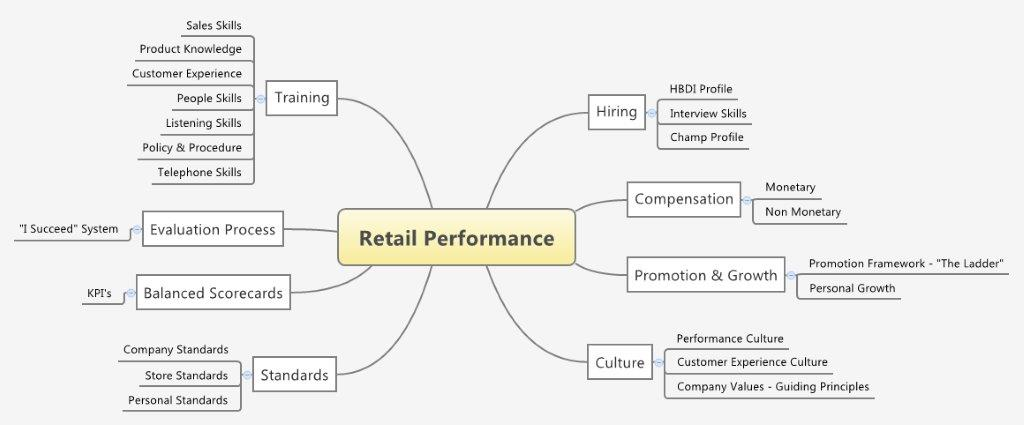
DMSRetail Performance Framework

DMSRetail Performance Framework


Retail Performance Framework

Hiring: A very important step in the performance process. They say if you have the hiring right you’ve won half the battle. DMSRetail Performance framework creates a powerful candidate profile using HBDI and the “Champ” tools.

Training: Along with right hiring, a formal training program which includes all of the areas mentioned above is a must. Many retailers either skip this altogether or do a pretty mediocre job, taxing the performance right from the get go.

KPI’s & The Balanced Score Card: Correctly designed balanced scorecard is at the heart of the performance process. Through this tool, we are able to communicate what the priorities and the expectations are.

Evaluation: On going and frequent evaluation is key to make sure everyone is steering towards the right objectives and also making sure that staff has the necessary skills and tools available to them and that they are using them effectively.

Compensation: A very important part of the performance puzzle, yet does not get the necessary attention from the top executives. Retail business is a selling business which means the foundation of the compensation plan should be “Pay for Performance”. It amazes us that there are retail executives that don’t understand or just plain refuse this concept.

Promotions: One of the very few good things that we have in retail business is the ability to move up relatively quickly, provided that the individual has what it takes. Once again, only DMSRetail has the right approach to this very powerful motivational vehicle.

Standards: Operational excellence depend largely on setting high standards and making sure that the whole company performs under the “Zero Tolerance” guidance. To achieve this will require a bit of effort at the beginning but once people embrace and habitualize it, it will be 100% each time, every time.

Culture: Probably the biggest job of all is to create the right culture and the 2 additional sub-cultures. Majority of the weight of this task belongs with the top manager and it is a constant and continuous battle. That is why we don’t see success in this Endeavour very often.

What To Do Next:

DMSRetail has developed a “30 Minute Retail Management Tune-Up” which we conduct over the telephone with you and your top staff members. Here is what we accomplish together in this fast-paced, zero nonsense session:

• Ideas on how to implement the DMSRetail Performance Framework in your company

The 30 Minute Retail Management Tune-Up is conducted by the principal of our company, Matt Parmaks M.Sc., who worked with more than 100 corporations including Sony, Bell and Praxium Group. Please be assured that this consultation will not be a thinly disguised sales presentation; it will consist of the best intelligence Mr. Parmaks can supply in a thirty minute time span. There is no charge for this call, but please be advised that the call must be strictly limited to 30 minutes.

This consult will typically take place within 1-2 weeks of your call. To secure a time for this consultation, please call Josephine Hill at +1 (312) 239-0919 or email jhill@dmsretail.com  and she will advise you regarding available time slots. She will also provide you with a pre-consultation questionnaire that will prepare both you and us to get maximum value in the shortest amount of time.


Enter your email address to follow this blog and receive notifications of new posts by email.

Retail Management Success

Ultimate Retail Success Collection

Retail Business Academy

Retail Business Academy

Archives

Sales & Influence Blogs - BlogCatalog Blog Directory